Best Filament for the Bambu Lab AMS: What Works, What Jams
The best filament for the Bambu Lab AMS: which materials and spool sizes work, why TPU, wet PVA and brittle filaments stay out, and how to standardize filament on shared Bambu printers.
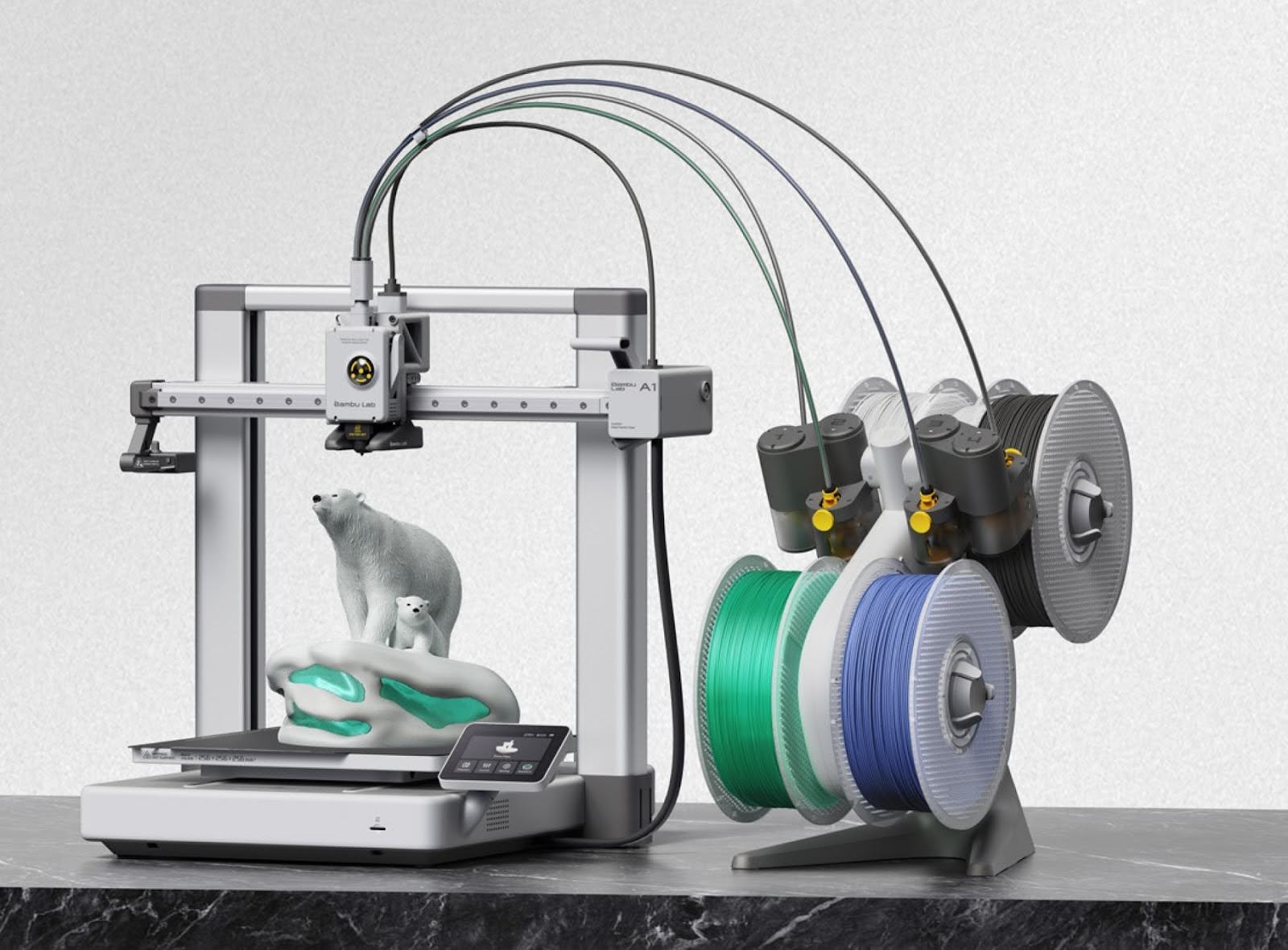




Short answer: The best filament for the Bambu Lab AMS is rigid filament on plastic spools: PLA, PETG and similar materials that are neither flexible nor brittle. Bambu filament with RFID tags is recognized automatically, while other brands work once you set the type and color. Avoid TPU, wet PVA, brittle and fiber-filled filaments, and use an adapter ring for cardboard spools.
Finding the best filament for the Bambu Lab AMS matters most when several people share the printers. One jam in the AMS stops a printer, and on a shared fleet it stops someone else's job. This guide sums up what Bambu Lab says works in the AMS, what to keep out, and how to standardize filament across a fleet of Bambu printers with Bambu Lab printer software.
The Automatic Material System (AMS) feeds filament from four slots into one printer, which lets it switch colors or materials during a print. According to Bambu Lab, up to four AMS units can be connected to one printer through an AMS hub, for up to 16 colors or materials. The AMS has no dryer; Bambu relies on its airtight design, two slots for desiccant bags and a humidity sensor that warns when the desiccant needs replacing.
Bambu Lab says the AMS is compatible with most filaments. The limits come from the feed path: the filament is pushed and pulled through tubes and a hub, so it must be stiff enough to push and tough enough not to snap.
| Material | In the AMS? | Bambu Lab's guidance |
|---|---|---|
| PLA | Yes | Rigid filament works; Bambu filament with RFID is recognized automatically. |
| PETG, PA, PC | Yes | The sealed AMS is described as ideal storage for hygroscopic filaments such as PA, PC, PVA and PETG. |
| TPU, TPE and other flexibles | No | Not compatible with elastic material; feed from an external spool holder instead. |
| Absorbent (wet) PVA | No | Avoid using the AMS for absorbent PVA. |
| Very hard or brittle filament | No | Avoid materials that are too hard (high modulus) or too brittle. |
| Third-party fiber-reinforced filament | No | Avoid PA-CF/GF, PET-CF/GF, PLA-CF/GF and similar third-party materials. |
| Filament on cardboard spools | With an adapter | Cardboard can shed debris and jam the system; use a spool adapter or adapter ring. |
Sources: Bambu Lab wiki, notes on the AMS and AMS function introduction; Bambu Lab blog, AMS explained in detail.
Check the spool before you buy in bulk. Bambu Lab states that the AMS supports spools 50-68 mm wide and 197-202 mm in diameter. Spools outside that range belong on an external holder. For a fleet, this is the most practical filter when choosing a second, cheaper brand: a good filament on the wrong spool still causes stops.
Bambu's own spools carry RFID tags on both sides, and the AMS has two RFID readers. With auto-read enabled, the AMS reads the tag when a spool is inserted or at startup, so spools can be loaded in any order and are identified automatically. Other brands work too: you set the material type and color in the slicer or on the printer's touch screen.
For a single printer, setting a type by hand is a small step. On a shared fleet, it is a common source of mistakes: a slot labeled PLA that holds PETG fails a print for someone who never touched it. Two simple rules help:
3DPrinterOS supports every current Bambu Lab printer in the X2, X1, H2, P2, P1, A1 and A2 series, connected in LAN Only Mode on all firmware versions. Its Bambu Lab slicer runs the Bambu Studio engine in the cloud, and you can keep using Bambu Studio for slicing. Teams keep one central library of filament profiles for consistent prints on every printer, and see how much filament every job uses, by person, group and printer. Admins can set a price per gram to turn that usage into a cost per job. 3DPrinterOS tracks the filament your prints use, not the spools on your shelves.
Bambu printers sit in the same queue as the rest of your fleet: 3DPrinterOS supports 200+ printer models from one dashboard. Duke University, for example, uses 3DPrinterOS to track individual users, machines and print jobs across its whole network. For multi-brand fleets, see 3D printer farm management software, and for the full feature set, our 3D printer management software. 3DPrinterOS is used by 500+ companies and universities, including NASA, NIH, Google and Koenigsegg, and is free for 14 days.
Rigid filament on plastic spools that fit the AMS, such as PLA and PETG. Bambu filament with RFID tags is recognized automatically; other brands work once you set the material type and color.
No. Bambu Lab says the AMS is not compatible with elastic material like TPU and advises against flexible materials such as TPU and TPE. Feed them from an external spool holder.
Yes. Bambu Lab says the AMS works with most filaments. Without an RFID tag, you set the color and material type in the slicer or on the printer's touch screen.
Bambu Lab advises against bare cardboard spools because they can shed debris and jam the system. Use a spool adapter or adapter ring, and check the spool is 50-68 mm wide and 197-202 mm in diameter.
3DPrinterOS records how much filament every job uses and shows it by person, group and printer, with a cost per job from a price per gram. It does not track spool stock.

Used by higher education, enterprises, and OEMs to manage printers, files, and users from a single, cloud-based platform

Control access, users, and print permissions by team or lab
“This close collaboration has enabled Koenigsegg to tailor the platform to their specific needs, resulting in an optimized and user-friendly system for managing their 3D printers.”

Team Leader
Koenigsegg Automotive AB
Book your personalized assessment now and get your free trial.