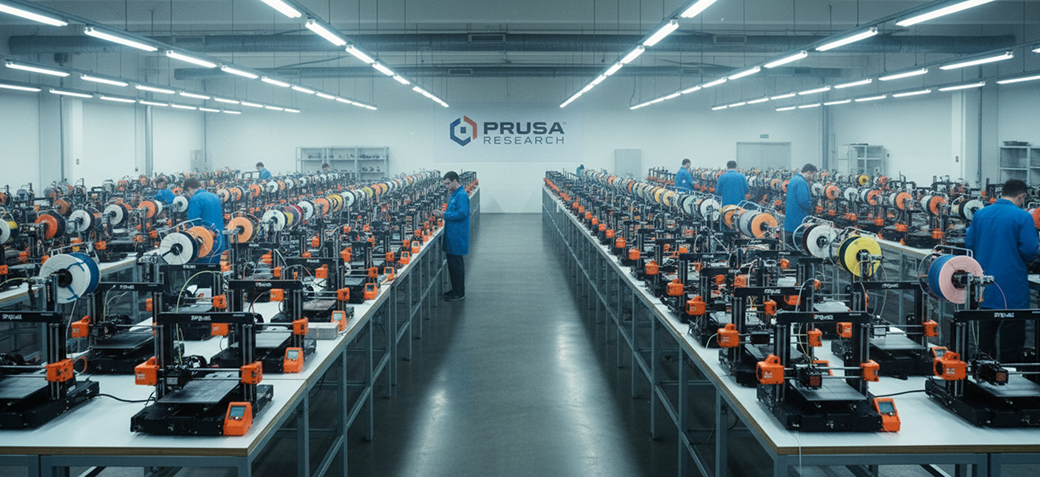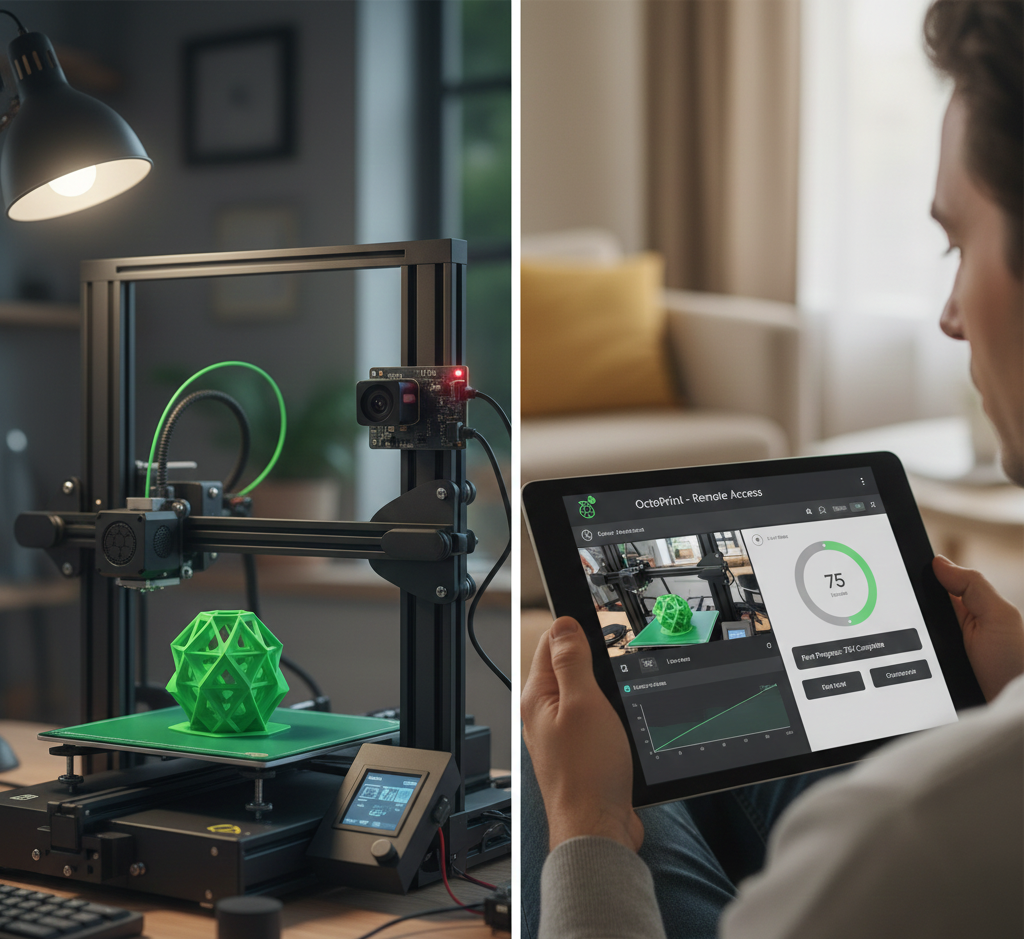


What happens when students, engineers, designers, and researchers can start 3D prints from anywhere without waiting for lab access or staff availability? The result is a smoother workflow, fewer bottlenecks, and a significant reduction in wasted time. This is the power of remote 3D printing: a cloud-supported approach that lets users send prints, monitor progress, and manage devices without being physically present.
Traditional 3D printing setups often demand close supervision and repeated visits to labs or production rooms. These inefficiencies lead to delays, long queues, and missed deadlines. Remote printing solves these challenges by providing universities and enterprises with modern tools to manage printers efficiently, enforce access rules, and streamline production across large groups of users.
What Is Remote 3D Printing?
Remote 3D printing is a method of managing printers from any connected device. Instead of walking to a machine to upload files or start a job, users rely on software to initiate and supervise prints. Files are uploaded securely, assigned to available printers, and monitored in real time. This workflow reduces physical interaction while increasing productivity.
Common Challenges in Traditional 3D Printing Setups
Many institutions still rely on in-person processes, which create slowdowns. Some of the most common challenges include:
- Long lines outside university labs during peak hours
- Students and engineers waiting for printers to become free
- Repeated walk-ins to check whether a print is done
- High staff involvement for manual queue management
- Frequent print failures due to missed supervision
- Abandoned or duplicate jobs wasting material and time
These issues create inefficiencies for both academic and corporate environments, especially when multiple users rely on a limited number of printers.
How Remote Printing Solves These Problems
Remote printing centralizes device control into an accessible digital platform. Jobs can be queued, scheduled, and assigned without stepping into the lab. Real-time monitoring eliminates the need for manual check-ins. Automated notifications track progress and alert users about failures.
This approach allows institutions to distribute printing more evenly. Instead of having a single location act as the bottleneck, prints can be routed to available machines across different departments or buildings. Staff can focus on core tasks instead of managing every file or supervising every print.
Time-Saving Benefits of Remote 3D Printing
Remote workflows drastically reduce time spent waiting, monitoring, or travelling to printing locations. Key benefits include:
- Fast job submission at any hour
- Automated queue systems that prevent conflicts
- Immediate print starts on available devices
- Reduced need for in-person oversight
- Timely updates that show print status
For universities, this means students finish projects faster. For enterprises, engineering teams push prototypes through the pipeline more quickly.
Cost and Resource Efficiency
Remote printing provides multiple financial advantages:
- Fewer failed prints reduce material costs
- Automated job management lowers staffing requirements
- Centralized oversight ensures optimal printer usage
- Reduced idle time increases overall throughput
- Analytics highlight issues before they become costly problems
These efficiencies help institutions maximize the value of their equipment while reducing the operational strain on IT, lab staff, and administrators.
Security and Access Control in Remote Printing
Security is essential when digital models include proprietary designs, research data, or intellectual property. Remote printing platforms include:
- Permission-based access
- Secure file transfers
- Encrypted communication
- Activity logs for accountability
- User-level restrictions
Universities can ensure that only authorized individuals submit prints, while enterprises can protect confidential engineering models.
How Universities Use Remote 3D Printing
Academic institutions have some of the highest demands for 3D printing. Remote systems support campus labs in several ways:
- Students submit files online instead of crowding labs
- Automated queue handling reduces conflicts
- Print history logs to make grading and project tracking easier
- Faculty gain insights into material usage and print volume
- Shared labs across campus become more accessible
Remote printing also supports hybrid learning. Students working off-campus can still prepare prints and send them to campus devices during non-peak hours.
How Enterprises Benefit from Remote Printing
Enterprises benefit equally from remote printing because it streamlines engineering, prototyping, and production workflows. Remote management supports:
- Distributed teams across offices and time zones
- Quick iteration cycles during product development
- Automated scheduling for large print farms
- Reduced downtime during nights or weekends
- Centralized control of multiple printers across departments
These workflows improve productivity for additive manufacturing teams, especially for organizations that work with large batches of prototypes or internal tooling.
The Role of Cloud Platforms in Scaling Remote Printing
Cloud platforms are central to remote printing. They eliminate complex local installations and give organizations a unified system to manage every printer. Their key features include:
- Real-time printer status
- Job distribution across fleets
- Cloud file storage
- Automatic software updates
- Permission settings for multi-user environments
- Data analytics for print performance
Universities benefit from cloud systems because they support thousands of users. Enterprises benefit because cloud architecture scales easily across global operations.
Future of Remote 3D Printing in Education and Industry
Remote printing will continue to grow as part of modern additive manufacturing. Future developments will likely include:
- AI-driven failure prediction
- Advanced analytics
- Tighter security integrations
- Automated material management
- Smarter job routing across print farms
These advancements will create faster, safer, and more efficient workflows for both academic and corporate environments.
The Smarter Way to Manage Time, Talent, and Technology
Remote printing empowers universities and enterprises to reduce delays, lower operational costs, and improve access to additive manufacturing. Centralized management and continuous oversight strengthen productivity and help organizations get more out of their equipment. The process becomes even more efficient when supported by strong 3D printer remote control capabilities for file preparation, job submission, and printer supervision.
Institutions worldwide rely on 3DPrinterOS to securely manage remote printing at scale. Contact us today and simplify remote printing for every user and every device.