


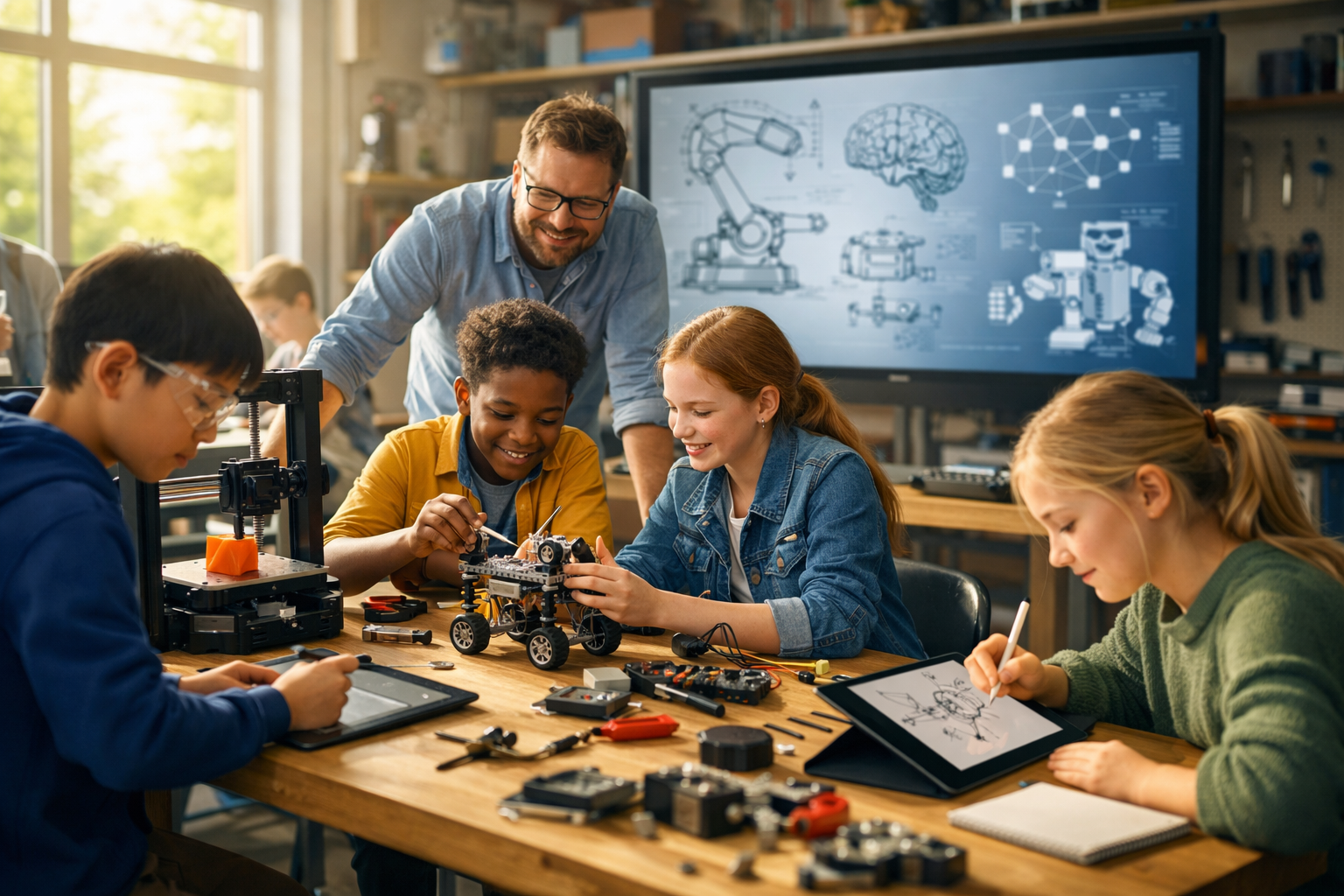


When it comes to STEM and innovation, schools often face the same big questions:
How do we scale technology thoughtfully? How do we support teachers? How do we create meaningful makerspaces? And how do we navigate AI without panic?
In a recent webinar hosted in partnership with 3DPrinterOS, Todd Martin, STEM and Innovation Lead, and Brent Haldi, Director of Technology at Columbus Academy, shared how their school has built a sustainable, forward-thinking STEM ecosystem—one that blends infrastructure, culture, leadership, and emerging technology.
Here’s a closer look at how they’re doing it.
A Strong Foundation: Tradition Meets Innovation
Founded in 1911, Columbus Academy has long been known for excellence in humanities, arts, and athletics. But over the last two decades—and especially the last ten years—the school has intentionally expanded its commitment to STEM and engineering.
Serving approximately 1,162 students from age 3 through grade 12, the school’s evolution toward innovation wasn’t accidental. It required:
- Leadership buy-in
- Parent support
- Strategic funding
- Dedicated space
- A willingness to “turn the ship”
As Todd shared, meaningful transformation takes more than tools—it takes alignment across the entire institution.
Building a Scalable Tech Ecosystem
Columbus Academy’s STEM success is rooted in a carefully managed technology infrastructure.
1:1 Device Program
- iPads for students in grades 1–12
- Devices refreshed every three years
- Students begin taking iPads home in grade 5
- Integration with Google Classroom and Google Workspace
The school recently transitioned to Logitech keyboard cases with trackpads to streamline device management and moved away from Apple Pencils due to logistical challenges.
Smart Classroom Infrastructure
- Interactive BenQ flat panels
- NFC card tap-to-login for teachers
- Seamless integration with Google Workspace
- Blackbaud as the student information system
- Jamf for device management and secure authentication
- Safe Internet filtering that follows devices home
This level of backend support ensures that teachers aren’t troubleshooting—they’re teaching.
As Todd emphasized, having on-demand tech support and administrative control over devices makes innovation possible. Teachers can experiment, try new tools, and take instructional risks because the infrastructure supports them.
From “Build It and They Will Come” to Purposeful Makerspaces
About seven to eight years ago, Columbus Academy committed to dedicated makerspaces. Initially, these spaces were built before a formal curriculum existed—a classic “build it and they will come” approach.
Over time, the school:
- Expanded its tech integration team (doubling in size in recent years)
- Offered professional development and conference opportunities
- Provided in-house grants to support teacher innovation
- Invested in equipment and software licenses
- Empowered teachers as administrators of their own devices
The result? A culture where innovation is supported structurally—not just encouraged rhetorically.
A Major Expansion: A Unified Innovation Hub
One of the most exciting developments is a new facility scheduled to open in spring 2026.
This renovated building will house:
- Lower school makerspace
- Middle and upper school makerspace
- Robotics programs
- The technology department
Bringing all innovation-focused programs under one roof creates cross-collaboration opportunities and reinforces STEM as a core institutional priority.
The move will happen mid-year—a logistical challenge—but also an opportunity to reimagine how space supports learning.
Navigating AI with Clarity, Not Chaos
No modern STEM conversation is complete without AI.
When AI tools rapidly entered classrooms, Columbus Academy experienced what many schools did:
- Enthusiasm from early adopters
- Concern from skeptics
- Uncertainty about policy
Rather than react impulsively, the school formed a committee to create shared language and clear expectations.
The Traffic Light Model
They developed a “traffic light” framework to guide AI usage:
- 🔴 Red: AI not permitted
- 🟡 Yellow: Limited or guided use
- 🟢 Green: AI encouraged
In the makerspaces, they are often in the “green light” zone.
Before AI, students sought inspiration from:
- Google Image searches
- Project repositories
- Make Magazine
Now, students often begin with structured “brain dumps” using Gemini. They refine ideas, generate directions, and explore possibilities before building. AI becomes a creative catalyst—not a shortcut.
The shift isn’t about replacing thinking—it’s about enhancing ideation.
The Secret Ingredient: Culture
What makes Columbus Academy’s approach stand out isn’t just hardware or software.
It’s:
- Leadership commitment
- Professional development support
- Internal grant opportunities
- Responsive tech teams
- Cross-department collaboration
- Willingness to evolve
Innovation here isn’t a side project—it’s embedded into the institution’s operating system.
Key Takeaways for Schools
If you’re looking to strengthen STEM and innovation at your own school, consider these lessons:
- Infrastructure matters. Reliable device management and tech support empower teachers.
- Space signals priority. Dedicated makerspaces demonstrate commitment.
- Support teachers continuously. Provide PD, conference opportunities, and innovation grants.
- Plan for AI intentionally. Clear frameworks reduce fear and confusion.
- Align leadership and funding. Sustainable innovation requires institutional backing.
- Expect evolution. The process is ongoing—not a one-time initiative.
Columbus Academy’s journey shows that meaningful STEM integration isn’t about chasing trends—it’s about building systems that allow creativity, technology, and pedagogy to thrive together.
And as AI, makerspaces, and digital tools continue to evolve, their approach offers a compelling model for schools looking to innovate with purpose rather than react to pressure.
The future of STEM education isn’t just about tools—it’s about thoughtful design, strong culture, and the courage to keep building.
By messaging ChatGPT, an AI chatbo


